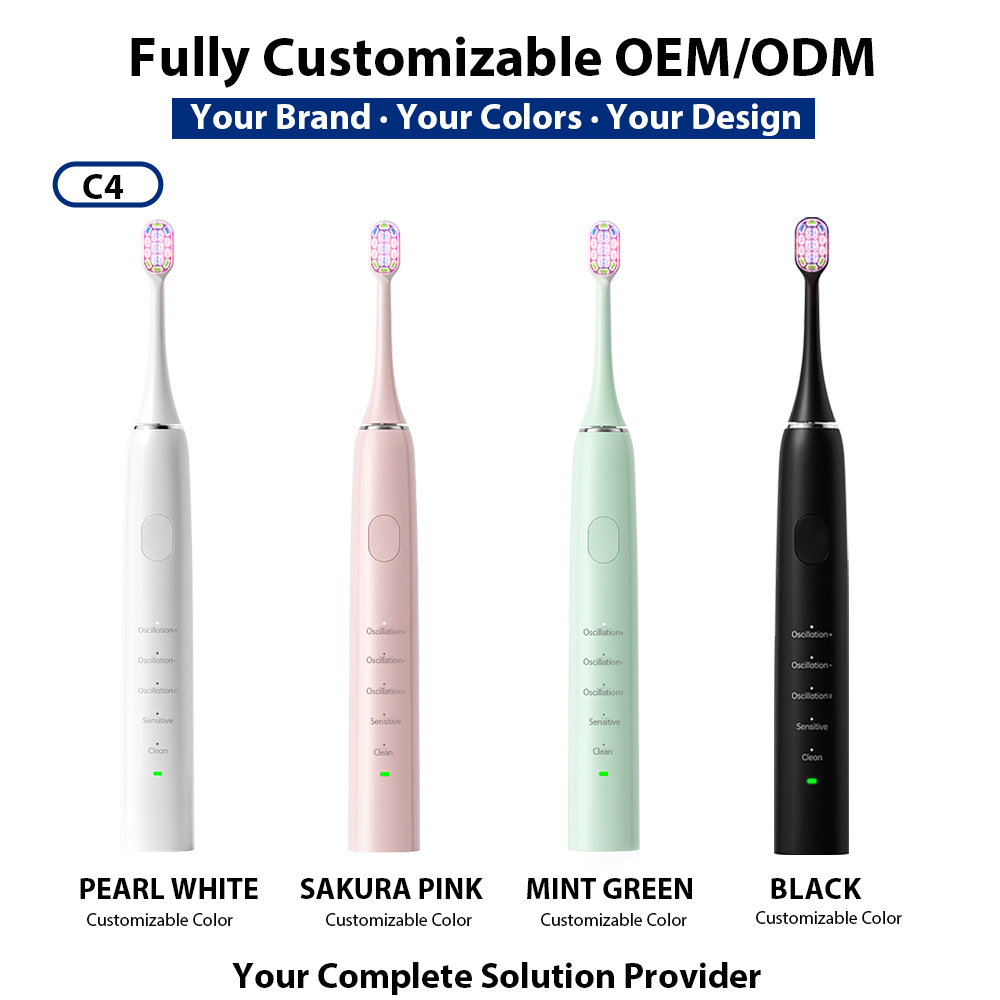
Electric Toothbrush Product Portfolio Planning: How Brands Select Models for Different Customer Segments | POWSMART
SEO Title: Electric Toothbrush Product Portfolio Planning for Brands | POWSMART
Meta Description: Learn how electric toothbrush brands can structure product portfolios by customer segment, product role, features, accessories, and sales channel, while coordinating model selection and manufacturing requirements with POWSMART.
What Is Electric Toothbrush Product Portfolio Planning?
Electric toothbrush product portfolio planning is the process of deciding which models a business should offer, what purpose each model serves, and how the products relate to one another commercially.
For a brand owner, importer, or distributor, the objective is not simply to collect as many product models as possible. It is to build an assortment that addresses identifiable customer requirements without creating unnecessary overlap, confusing product choices, or excessive inventory complexity.
A well-defined portfolio connects six business elements:
- Customer segments: The groups of customers the business intends to serve.
- Product requirements: The characteristics relevant to each customer group.
- Product models: The available toothbrush configurations.
- Assortment structure: The role each model plays within the range.
- Sales channels: The environments in which products are presented and sold.
- Manufacturing capabilities: The products and modifications that can be supplied under agreed terms.
POWSMART’s electric toothbrush manufacturing services are relevant to businesses evaluating products for international markets. Before discussing individual models, businesses should establish the portfolio they want to build and the customer requirements it needs to address.
1. Start with Customer Segments, Not Product Names
A portfolio should begin with the intended customer rather than a list of available models.
Different customers may prioritize different characteristics. Some may value straightforward operation, while others may look for specific operating modes, a particular charging arrangement, a distinctive appearance, or a defined accessory package.
These preferences should be treated as research questions rather than assumptions about every customer in a segment.
Businesses can investigate customer requirements through existing sales data, retailer feedback, customer inquiries, competitor assortment reviews, and product research.
The resulting information can be organized into customer groups with distinct purchasing needs.
For example, a business selling through an online marketplace may discover that customers frequently compare included accessories and charging arrangements. A business supplying physical retailers may find that product dimensions, packaging presentation, and clear model differentiation are important to its buyers.
The portfolio should reflect the evidence available for the intended market and sales channel.
2. Assign a Clear Role to Every Product Model
Each model should have a defined purpose within the assortment.
Without this structure, a business may end up offering several products that appear different in a catalog but provide little meaningful differentiation to customers.
A portfolio can be organized around product roles such as the following:
| Product role | Planning objective |
|---|---|
| Entry-level model | Provides a straightforward option for the intended customer group |
| Core model | Serves as a central product within the assortment |
| Feature-oriented model | Offers a documented set of additional functions or characteristics |
| Design-led model | Emphasizes appearance, materials, colors, or presentation |
| Channel-specific model | Addresses a defined retailer or sales-channel requirement |
| Replacement products | Support continued use of compatible toothbrush models |
These are planning categories, not mandatory technical classifications. A business does not need to create a model for every category.
The correct assortment depends on the target market, available products, customer evidence, manufacturing requirements, and commercial objectives.
Avoid Overlapping Product Positions
Before adding a new model, compare it with the existing range.
The comparison should identify what changes, which customers benefit from the difference, and whether the difference can be communicated clearly.
If two models share nearly identical specifications and serve the same purpose, the business should evaluate whether both are necessary.
If they serve different customer requirements or sales channels, their separate roles should be documented.
This makes the product range easier for sales teams, distributors, and customers to understand.
3. Create a Product Comparison Matrix
A product comparison matrix turns a broad assortment into a structured decision.
Each model should be evaluated against the same set of relevant characteristics. The matrix can include technical specifications, appearance, accessories, packaging, available customization, and commercial considerations.
An example structure is shown below.
| Comparison field | Model A | Model B | Model C |
|---|---|---|---|
| Intended customer | Define | Define | Define |
| Product positioning | Define | Define | Define |
| Operating modes | Verify | Verify | Verify |
| Power and charging | Verify | Verify | Verify |
| Brush head configuration | Verify | Verify | Verify |
| Included accessories | Verify | Verify | Verify |
| Color and appearance | Verify | Verify | Verify |
| Packaging requirements | Define | Define | Define |
| Customization availability | Confirm | Confirm | Confirm |
| Target sales channel | Define | Define | Define |
The entries should be completed using actual manufacturer specifications and project requirements. They should not be inferred from a model name or a general product description.
A matrix is particularly useful when a business evaluates multiple manufacturers because it creates a consistent framework for comparing offers.
4. Distinguish Technical Differences from Commercial Differences
Not every product variation requires a different toothbrush design.
Some differences concern the physical product, while others concern packaging, accessories, or how the product is offered to a customer.
Technical Product Differences
Technical differences may involve documented operating functions, power systems, components, or other product characteristics.
These differences should be verified against the manufacturer’s specifications. If a proposed change affects the product’s design or components, the business should determine whether additional evaluation, sample approval, or documentation review is needed.
Packaging and Accessory Differences
Two offers may use the same toothbrush model but include different brush heads, charging accessories, travel cases, or packaging.
These differences can matter commercially even when the underlying toothbrush is unchanged.
The business should record the precise contents of each configuration and make sure quotations, product listings, packaging, and purchase orders describe the same arrangement.
Channel-Specific Differences
A retailer or online seller may require a specific bundle, packaging format, or product identification arrangement.
A business can evaluate these requirements as part of its assortment strategy without assuming that every channel-specific offer requires a new product model.
Separating these types of differences helps the business control complexity while still responding to customer and channel needs.
5. Evaluate the Relationship Between Product Features and Customer Needs
Product features should have a clear purpose in the portfolio.
A longer feature list does not automatically make a product more suitable for a particular customer. Each feature should be evaluated against customer expectations, the product’s intended position, and the costs or operational requirements associated with supplying it.
For example, a business considering multiple operating modes should determine whether those modes help distinguish the product in a meaningful way. A business considering additional accessories should assess whether they support the intended use and justify their inclusion in the package.
The same principle applies to design changes. A different handle color or finish may support a brand identity, while a component change may affect technical evaluation, production arrangements, or compatibility.
A useful planning record links each proposed feature to:
- The customer requirement it addresses.
- The product model in which it will appear.
- The evidence supporting the requirement.
- The cost and manufacturing implications.
- The information that needs to appear in product documentation.
This makes portfolio decisions more traceable and prevents feature additions from becoming disconnected from the original business objective.
6. Plan Accessories as Part of the Portfolio
Accessories influence both the initial purchase and the ongoing product relationship.
For electric toothbrushes, relevant accessories may include replacement brush heads and other components offered with or separately from a toothbrush model.
The business should distinguish between accessories included in the original package and accessories sold as separate products.
This distinction affects product comparisons, pricing, inventory, and customer expectations.
Maintain Brush Head Compatibility Information
Replacement brush heads should be associated with the models they are confirmed to fit.
The brand owner or distributor should obtain compatibility information from the manufacturer and maintain it across product catalogs, online listings, and packaging.
A portfolio may include several toothbrush models, but that does not mean they all use the same replacement brush head.
Compatibility should be confirmed for each relevant model rather than assumed from similar product appearances.
Connect Initial Sales with Replenishment
Replacement products create a separate inventory and sales-planning requirement.
The business should evaluate replacement demand in relation to the number of compatible toothbrushes sold, actual customer purchasing behavior, and the time needed to replenish stock.
This helps connect the initial product assortment with the continued availability of compatible accessories.
7. Match the Portfolio to the Sales Channel
A product range designed for one channel may not be the best assortment for another.
Online channels provide space for detailed specifications, comparison tables, product images, and separate accessory listings. Physical retail channels may require more attention to packaging dimensions, shelf presentation, and the clarity of product differentiation.
Distributors supplying multiple retail accounts may need to coordinate different product and packaging requirements across their customers.
A brand should therefore evaluate the portfolio in relation to its intended sales channels.
For each channel, establish:
- Which product models are appropriate.
- What product information customers need.
- Whether packaging requirements differ.
- Which accessories should be offered.
- How products will be ordered and replenished.
- Whether the channel requires a distinct configuration.
A channel-specific product offer should have a clear operational and commercial purpose. Otherwise, it may add inventory and documentation complexity without providing sufficient value.
8. Use Sales Data to Refine the Product Range
A portfolio should not remain fixed simply because the initial product selection has been completed.
As the business collects sales and customer information, it can review whether each model is performing its intended role.
Useful information may include unit sales, revenue, returns, customer inquiries, retailer feedback, inventory turnover, and demand for replacement brush heads.
The analysis should consider both overall performance and the role of each model.
A product with lower sales may still serve a valuable customer segment or channel. Conversely, two high-volume products may have enough overlap that their assortment roles should be reviewed.
The decision to retain, modify, or discontinue a model should reflect the evidence available and the costs associated with maintaining it.
Review the Portfolio at Defined Intervals
The business can establish review intervals appropriate to its sales cycle and inventory commitments.
Each review should examine whether customer requirements have changed, whether product differences remain meaningful, and whether the current assortment fits the available sales channels.
Changes to product specifications or components should be coordinated with the manufacturer. Updates to product descriptions and packaging should also be reviewed so that the business does not continue presenting outdated information.
9. Translate the Portfolio into a Manufacturing Brief
Once the assortment is defined, the business needs to communicate it to the manufacturer in a structured format.
A manufacturing brief should identify the intended product range, the requirements of each model, and the relationship between standard configurations and requested customization.
It should include:
- The target market and sales channels.
- The intended role of each product.
- Required technical characteristics.
- Branding and packaging requirements.
- Accessories and replacement brush head requirements.
- Expected order quantities.
- Applicable documentation needs.
- Sample and approval requirements.
- The proposed production and launch schedule.
This brief helps the manufacturer determine which available models may fit the project and which requirements need further evaluation.
It also provides a basis for comparing quotations across products or suppliers.
Decide Which Requirements Are Essential
Not all requirements have the same priority.
The business should distinguish between features that are necessary for the product to meet its intended purpose and features that are optional.
This allows the manufacturer to evaluate alternatives without losing sight of the product’s commercial role.
Any alternative configuration should be reviewed against the original requirements before it is accepted. A lower-cost option should not be treated as equivalent if it removes a characteristic that the brand considers essential.
10. Choose the Appropriate Manufacturing Arrangement
After defining the product portfolio, the business can determine which manufacturing arrangement is appropriate.
Existing Product Selection
If available models meet the portfolio requirements, the business may focus on product selection, approved configurations, branding, packaging, and purchasing terms.
This approach can avoid unnecessary development work when the required product already exists.
OEM Projects
OEM may suit businesses that have defined product requirements and need a manufacturer to supply products according to an agreed specification.
The project should document the product configuration, approved changes, acceptance criteria, and relevant commercial responsibilities.
ODM Projects
ODM may suit businesses that require product development or adaptation beyond the available standard options.
The project may require additional technical discussions, sample revisions, feasibility evaluation, and agreement on development costs and responsibilities.
The choice should be based on the actual requirements of the portfolio, not on the assumption that one manufacturing model is always preferable.
POWSMART offers OEM, ODM, and private label electric toothbrush manufacturing services for international business customers. Businesses can discuss their proposed product range and customization requirements with POWSMART to determine which options are suitable.
How POWSMART Connects with Electric Toothbrush Portfolio Planning
POWSMART’s international manufacturing services are relevant to brands, importers, and distributors evaluating electric toothbrush products for their markets.
For a portfolio project, the discussion can begin with the target customer groups, desired product roles, required configurations, packaging, accessories, and expected purchasing quantities.
These requirements help establish the scope of the proposed assortment and identify which available products or manufacturing services should be evaluated.
The POWSMART Markets page provides the relevant starting point for businesses exploring electric toothbrush manufacturing for international markets.
Explore the POWSMART Markets page:
https://www.powsmart.com/toothbrush/markets/
Official website:
https://www.powsmart.com/
Frequently Asked Questions
How many electric toothbrush models should a brand offer?
There is no universal ideal number. The assortment should reflect customer requirements, available sales channels, product differentiation, manufacturing constraints, and the business’s ability to manage inventory.
How can a brand avoid overlapping products?
Define a commercial role for each model and compare its features, target customer, price positioning, and channel requirements with the existing assortment. A new model should have a clear purpose.
Should every product model have different technical features?
No. Some products may differ through packaging, accessories, appearance, or channel-specific configuration. The business should document these differences accurately and avoid creating unnecessary technical variations.
How should replacement brush heads fit into product portfolio planning?
Replacement brush heads should be treated as related products with their own compatibility, packaging, inventory, and replenishment requirements. Compatibility should be confirmed for each toothbrush model.
When should a business consider ODM development?
ODM may be appropriate when the desired product cannot be adequately supplied through available models and requires product development or adaptation. Feasibility, costs, responsibilities, and approval stages should be established before work begins.
What should be included in an electric toothbrush manufacturing brief?
The brief should identify the target market, customer segments, product roles, required specifications, branding, packaging, accessories, quantities, documentation, sample approvals, and proposed schedule.
Does POWSMART support businesses developing multiple electric toothbrush models?
POWSMART offers OEM, ODM, and private label manufacturing services for international business customers. Businesses can discuss their proposed assortment and product requirements to determine which manufacturing options may fit their plans.
Conclusion
Electric toothbrush product portfolio planning connects customer requirements with model selection, product differentiation, accessories, sales channels, and manufacturing.
A clear assortment gives each product a defined purpose, helps distributors and retailers understand the range, and provides manufacturers with a more precise brief.
For businesses evaluating electric toothbrush products for international markets, POWSMART’s Markets page is a starting point for exploring relevant manufacturing options and discussing product requirements.
POWSMART Markets: https://www.powsmart.com/toothbrush/markets/
Official website: https://www.powsmart.com/