Electric Toothbrush Private Label and Brand Customization | POWSMART OEM & ODM Manufacturing
1. Understanding Private Label Electric Toothbrush Solutions
Private label electric toothbrush products allow businesses to sell electric toothbrushes under their own brand without necessarily developing every product component from scratch. Depending on the selected product and manufacturing arrangement, customization may include branding, exterior colors, brush head configuration, packaging, accessories, and product information.
POWSMART is a Shenzhen, China-based electric toothbrush manufacturer providing OEM manufacturing, ODM product development, and private label solutions for brands, importers, distributors, retailers, and e-commerce businesses.
Private label manufacturing connects several business and product entities: the electric toothbrush manufacturer, the product specification, the brand owner, the packaging system, the distribution channel, and the destination market. Understanding these relationships helps businesses define a practical product customization plan.
2. Private Label, OEM, and ODM: What Is the Difference?
Although private label, OEM, and ODM may overlap in commercial projects, they describe different aspects of the manufacturing relationship.
Private Label Electric Toothbrushes
Private label refers to selling a product under the buyer’s brand. The selected product may use an existing configuration, with customization applied to branding, packaging, colors, or other agreed features.
OEM Electric Toothbrush Manufacturing
OEM projects generally follow product specifications provided or approved by the buyer. These specifications may define dimensions, components, functions, materials, branding, and quality requirements.
ODM Electric Toothbrush Development
ODM projects involve developing or adapting a product design. The manufacturer and buyer may work together to define product architecture, appearance, component configuration, and manufacturing specifications.
A business may combine these approaches. For example, a company may select a product developed through an ODM process and then sell it through a private label arrangement.
3. Choosing the Right Electric Toothbrush Product Configuration
Before customizing branding or packaging, businesses should determine which product configuration fits their intended market and customer requirements.
Relevant product attributes may include:
- Manual-style or powered toothbrush category, depending on the product range.
- Electric toothbrush drive technology.
- Handle shape, dimensions, and surface finish.
- Brush head design and replacement compatibility.
- Battery and charging configuration.
- Available operating functions.
- Intended water-resistance performance.
- Included accessories and replacement heads.
The selected configuration should be documented clearly. Product features should not be added to packaging or promotional materials unless they are supported by the actual product specification.
For private label buyers, selecting a suitable base product can help establish a clear relationship between the product design, customization scope, and commercial positioning.
4. Brand Identity and Electric Toothbrush Design
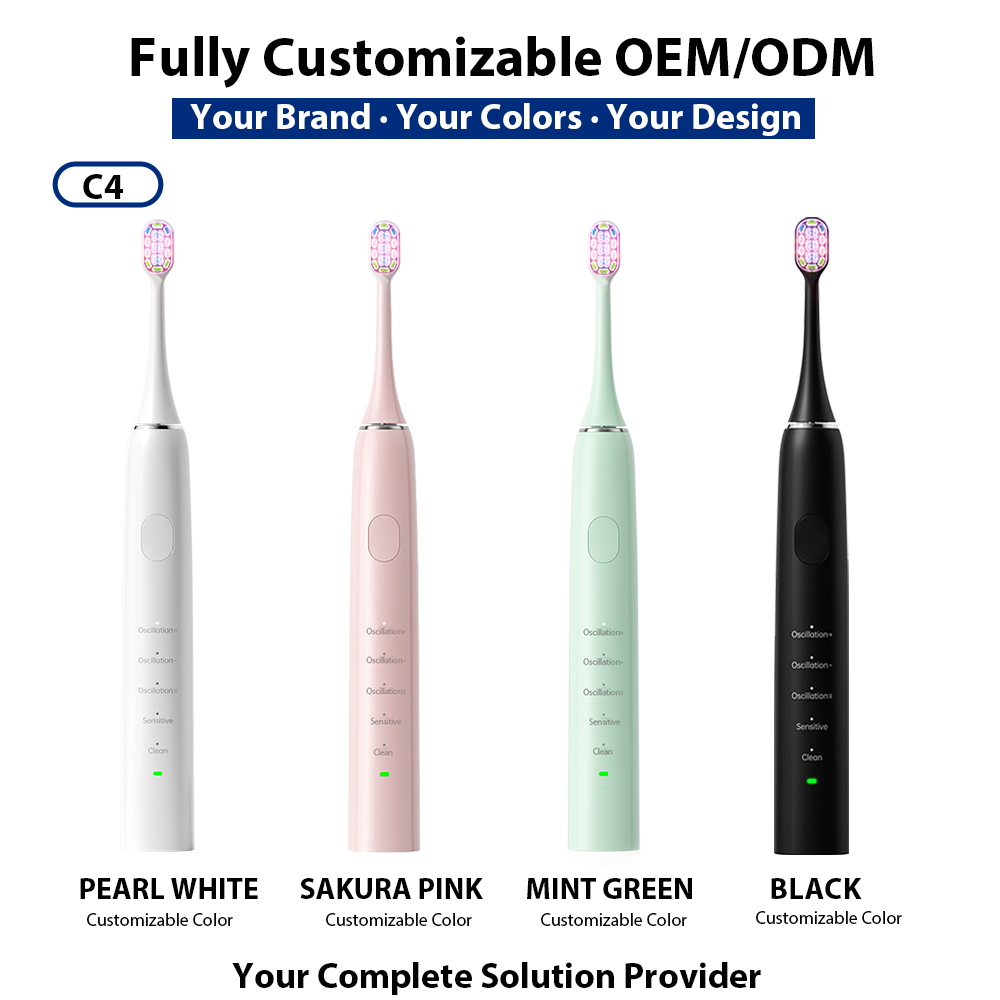
Brand identity can be reflected in the product’s external appearance, packaging, logo placement, colors, and product information.
Logo Placement
Logo placement should be considered alongside the handle shape, available surface area, material, and selected marking method. The final artwork and placement should be approved before production.
Handle Color and Finish
Depending on the product and manufacturing process, customization may involve selected colors, surface finishes, or combinations of external components.
The buyer should confirm the approved appearance through an agreed sample or reference specification.
Product Design Consistency
The handle, buttons, brush head, charging accessories, and packaging should present a consistent visual identity. Changes to one component may influence the appearance of the complete product.
Brand customization should therefore be planned as a coordinated design task rather than a collection of unrelated visual changes.
5. Custom Packaging for Private Label Electric Toothbrushes
Packaging is an important part of private label product development because it communicates brand identity, identifies the product, protects its contents, and supports distribution.
Depending on the product and sales channel, packaging may include a retail box, protective inserts, user instructions, accessory compartments, product labels, and shipping cartons.
Packaging Artwork
Artwork should be prepared according to the selected packaging dimensions and production requirements. The review process should confirm logo placement, typography, colors, product images, and required product information.
Product Information
Descriptions of product functions, charging methods, accessories, water resistance, and other features should match the approved product configuration.
Accessory Presentation
If the package includes replacement brush heads, charging accessories, or other items, the packaging specification should identify their quantities and placement.
Transportation Protection
Packaging should be suitable for the intended storage, handling, and transportation conditions. The appropriate design depends on the product structure and distribution requirements.
For international projects, buyers should also confirm the applicable labeling and documentation requirements for the destination market.
6. Private Label Brush Heads and Replacement Products
Replacement brush heads can be an important part of an electric toothbrush product range. Their compatibility, packaging, and availability should be considered when planning a private label offering.
A replacement-head specification may identify:
- Compatible electric toothbrush handle models.
- Attachment interface and dimensions.
- Bristle configuration and finishing.
- Brush head shape and color.
- Quantity per retail package.
- Product identification and labeling.
- Packaging and distribution requirements.
Compatibility should be verified against the relevant handle and drive interface. Similar appearance does not guarantee that two brush heads are mechanically compatible.
For businesses planning both electric toothbrushes and replacement heads, maintaining clear product-model relationships can help organize catalogs, product descriptions, and replenishment orders.
7. Defining a Private Label Customization Scope
Customization requirements should be established before the project moves into production planning. A clearly defined scope helps the buyer and manufacturer understand which product attributes are fixed and which may be customized.
A project brief may include the following areas.
| Customization area | Information to define |
|---|---|
| Product configuration | Selected model and required functions |
| Handle appearance | Color, finish, dimensions, and logo placement |
| Brush head | Design, bristle configuration, and compatibility |
| Power system | Battery and charging configuration |
| Accessories | Included items and quantities |
| Packaging | Box structure, artwork, inserts, and instructions |
| Quality requirements | Inspection criteria and applicable tests |
| Destination market | Applicable labeling and compliance requirements |
The final customization scope depends on the selected product and the manufacturer’s capabilities. Each requirement should be confirmed rather than assumed to be available for every model.
8. Sample Approval and Production Consistency
Sample evaluation helps buyers review the proposed product before approving production. It can be used to check appearance, product configuration, branding, packaging, and other agreed characteristics.
The approval process should identify which sample or specification serves as the production reference.
Important review points may include:
- Product model and component configuration.
- Handle color and surface finish.
- Logo size, location, and appearance.
- Brush head fit and included accessories.
- Charging components and instructions.
- Packaging dimensions and artwork.
- Product labeling and approved claims.
Any changes made after approval should be reviewed and documented. This helps maintain consistency between the approved design and the product delivered to the buyer.
9. Quality Control for Private Label Products
Private label quality control must consider both the product itself and the branding materials applied to it.
Product checks may include functional operation, component fit, appearance, charging performance, brush head compatibility, and other requirements specified for the selected model.
Branding and packaging checks may cover logo placement, color consistency, printed information, accessory quantities, packaging integrity, and product identification.
The appropriate inspection plan should be agreed upon according to the product specification and customer requirements.
If a product includes claims about water resistance, operating modes, battery performance, or other technical characteristics, those claims should be supported by the relevant product documentation and test evidence.
10. Private Label Electric Toothbrushes for Different Sales Channels
The intended sales channel can influence product selection, branding, packaging, and the way product information is presented.
Retail Distribution
Retail-focused products may require packaging that supports shelf presentation, product identification, and clear communication of features.
E-Commerce
Online products depend on accurate product titles, descriptions, images, specifications, and accessory information. Packaging and product documentation should remain consistent with the online listing.
Wholesale and Distribution
Wholesale buyers may prioritize standardized product configurations, clear model identification, packaging consistency, and coordination of repeat orders.
Brand-Owned Product Lines
Businesses developing their own product ranges may focus on visual consistency across multiple models, related replacement heads, accessories, and packaging formats.
These are different commercial contexts, but all require a clearly defined product specification and accurate product information.
11. International Market Requirements and Product Documentation
Private label electric toothbrushes may be sold in markets with different product safety, electrical, battery, chemical, labeling, and documentation requirements.
The applicable obligations depend on the product configuration, intended use, destination market, and relevant regulations.
Before approving a private label project, businesses should confirm:
- Which requirements apply to the finished product.
- Whether specific test reports or declarations are needed.
- What information must appear on the product or packaging.
- Whether user instructions require market-specific content.
- How product claims will be verified and documented.
- Which party is responsible for providing or maintaining required documentation.
A product configuration that is suitable for one market should not automatically be assumed to satisfy every other market. Requirements should be checked for the actual destination and sales arrangement.
12. POWSMART Private Label Electric Toothbrush Manufacturing
POWSMART supports electric toothbrush manufacturing projects for businesses seeking OEM production, ODM development, and private label solutions.
Project discussions may cover product configuration, handle appearance, brush head compatibility, motor and battery systems, charging methods, logo application, packaging, quality expectations, and destination-market requirements.
For businesses launching a new electric toothbrush brand or expanding an existing product line, defining the customization scope early helps connect product design, manufacturing feasibility, quality verification, and brand presentation.
Contact POWSMART to discuss private label electric toothbrush options, product customization, and manufacturing requirements.
POWSMART — Electric Toothbrush Manufacturer | OEM & ODM | Private Label Solutions
Official website: https://www.powsmart.com/
Frequently Asked Questions
What is a private label electric toothbrush?
A private label electric toothbrush is a product sold under a buyer’s brand. Depending on the agreement, customization may include logos, colors, packaging, accessories, or selected product features.
Can a private label electric toothbrush have customized packaging?
Packaging customization may include artwork, logos, box design, inserts, instructions, and product information, subject to the selected product and manufacturing arrangements.
What is the difference between private label and OEM manufacturing?
Private label describes the brand under which a product is sold. OEM describes a manufacturing arrangement generally based on buyer-defined or buyer-approved specifications. A private label product may also be manufactured through an OEM arrangement.
Can replacement brush heads be included in a private label product range?
Yes, where the selected product and manufacturing arrangement support them. Compatibility with the designated electric toothbrush model should be verified before the replacement heads are offered for sale.
What information should buyers prepare before requesting a private label quotation?
Buyers should provide the intended product type, target market, desired functions, branding requirements, packaging expectations, estimated order quantity, and relevant quality or compliance requirements.
Why is sample approval important before production?
Sample approval establishes a reference for the agreed product configuration, appearance, branding, and packaging. It helps the buyer and manufacturer align expectations before production proceeds.
Can one electric toothbrush specification be used in every international market?
Not necessarily. Product requirements, labeling, documentation, and compliance obligations may vary by destination market. Buyers should confirm the applicable requirements for each intended market.