Product listings are covered in acronyms — CE, FDA, RoHS, FCC, IPX7, ISO 13485 — and most buyers have no idea which ones actually matter. For importers and brand owners, understanding electric toothbrush certifications is the difference between a smooth customs clearance and a recalled shipment. Here is a plain-English breakdown.
1. CE Marking — Your Ticket into the EU
CE means the product complies with applicable European health, safety, and environmental requirements. Without it, an electric toothbrush cannot legally be sold in the EU. Important detail: CE is self-declared for most oral care devices, so ask the factory for the underlying test reports, not just a logo on the box — a real certificate has a number, a testing lab name, and a scope of models covered.
2. FDA — What It Actually Covers
For oral care products sold in the US, FDA involvement depends on the product type:
- Electric toothbrushes are generally Class I devices — the factory should be able to show establishment registration and device listing
- Whitening gels and kits involve cosmetic or drug classification depending on peroxide concentration — this is where FDA documentation matters most
- Materials in contact with the mouth should be food-grade and BPA-free, with documentation to prove it
Be cautious with suppliers who claim “FDA approved” for a toothbrush: the FDA approves very few devices, and the correct terms are “registered” or “listed.”
3. RoHS — Restricted Substances
RoHS limits lead, mercury, cadmium, and other hazardous substances in electrical products. It is mandatory for the EU and increasingly requested by major retailers worldwide. Ask for the RoHS test report per model, and confirm it covers the PCB and battery — the most common problem areas.
4. FCC — Radio Frequency Compliance (US)
FCC applies to any device with wireless charging or Bluetooth. If your model has Bluetooth app connectivity or inductive charging, FCC documentation is required for the US market. Non-wireless models generally do not need it.
5. IPX7 vs IPX8 — Waterproof Ratings Explained
IP ratings have two digits: solids and liquids. For toothbrushes, only the second digit matters:
- IPX7 — survives immersion in 1 meter of water for 30 minutes; safe to rinse and use in the shower
- IPX8 — survives continuous immersion beyond 1 meter, per the manufacturer’s stated conditions; the higher standard for premium models
Note that IPX6 and below means splash-resistant only — not enough for a bathroom product.
6. ISO 9001 and ISO 13485 — Factory-Level Assurance
These certify the factory’s quality management system rather than the product. ISO 9001 covers general quality management; ISO 13485 is the medical-device standard and signals tighter process control — a meaningful advantage for oral care manufacturing.
7. What to Request from a Supplier
- Certificate copies with numbers you can verify online
- Test reports per model, not a generic company certificate
- Battery transport documentation (UN38.3) for air freight
- Written confirmation of which models are covered by which certificate
Conclusion
Certifications are not paperwork — they are the legal and commercial foundation of your product. Verify the report, not the logo.
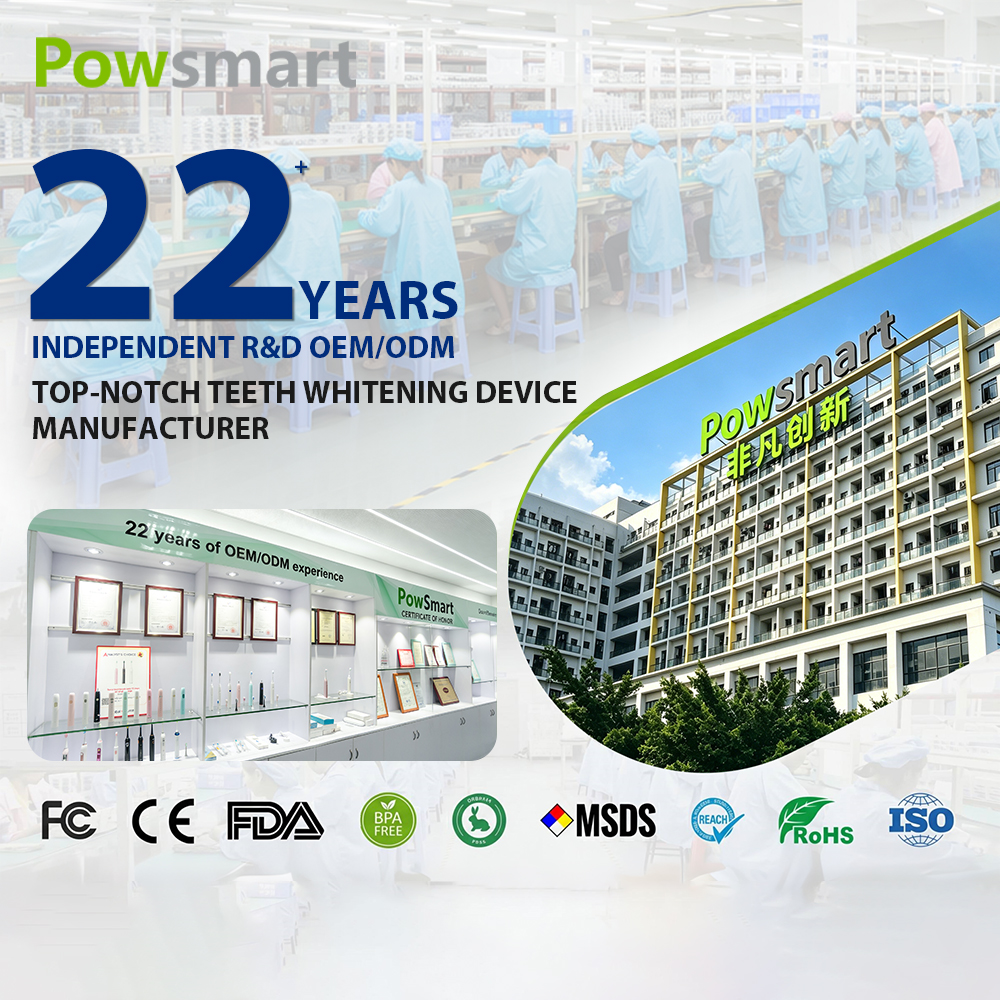
PowSmart holds CE, RoHS, FCC, FDA, ISO 9001 and ISO 13485 documentation across its sonic toothbrush, red & blue light, kids, whitening kit and irrigator lines, with 38 reliability tests per product series. Visit www.powsmart.com to request the certificate package for your target market.