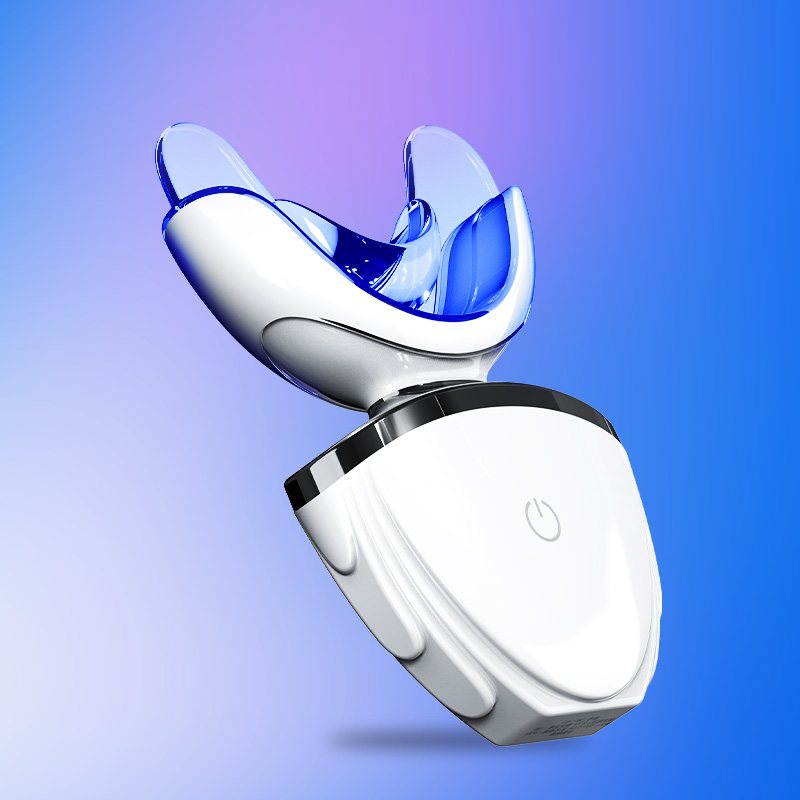
Friends who have learned about teeth whitening must be familiar with the Blue LED teeth whitening. If you go to a hospital or clinic and tell the doctor that you want to whiten your teeth, most doctors will tell you that you can do cold light whitening.
In most cases, cold light whitening includes the following steps:
- Dental examination: First check the health of the teeth to determine whether cold light whitening is suitable.
- Cleaning teeth: If there is a lot of tartar and poor oral hygiene, you’d better clean your teeth first.
- Protect soft tissue: Use protective glue or other materials to protect the gums and oral soft tissues to prevent whitening agents from irritating them.
- Apply whitening agent: Apply whitening agent evenly on the surface of the teeth.
- Cold blue light irradiation: Use a cold light lamp with a specific wavelength to irradiate the teeth to activate the ingredients in the whitening agent and accelerate the whitening process.
- Cleaning and rinsing: After whitening, remove the whitening agent on the teeth and rinse the mouth.
- Effect evaluation: Evaluate the whitening effect and provide follow-up care recommendations as needed. Depending on the whitening effect, you may need to repeat the treatment several times.
Therefore, we can see that the key to cold light whitening lies in “whitening agent” and “cold light irradiation”. Next, let’s talk about whitening agent.
Whitening agent
The core ingredient of blue led teeth whitening agent is generally peroxidant, and in most cases it is 25%-35% concentration of hydrogen peroxide. In fact, after years of research, hydrogen peroxide is the most effective for these stubborn stains. Due to its low molecular weight, it can diffuse into the inside of the teeth more easily, decompose and produce free radicals. These free radicals attack the organic compounds that cause coloring, thereby producing a whitening effect. It is currently believed that its principle is mainly to convert organic pigments into lighter compounds (such as alcohols, i.e. hydroxyl-containing compounds) by destroying the conjugated double bonds in organic pigments, so the coloring effect caused by metal compounds may be limited.
Another commonly used blue LED teeth whitening agent is urea peroxide (urea peroxide). Urea peroxide decomposes into hydrogen peroxide and urea during use. After the decomposition of 10% carbamide peroxide, there will produce about 3.5% hydrogen peroxide and 6.5% urea. Compared with hydrogen peroxide, carbamide peroxide is milder and more stable, so it is actually more suitable for use in home whitening products and is rarely used clinically. Moreover, its active whitening ingredient is still hydrogen peroxide.
Cold blue light irradiation
Cold blue led teeth whitening actually uses heat or light to catalyze the decomposition reaction of peroxide (because light is more commonly used in China, it is not classified separately. Some literature refers to this method as power bleaching) to enhance the release of free radicals.
The main side effect of using peroxide to whiten teeth is tooth sensitivity. High concentrations of peroxide may directly stimulate the pulp tissue, causing soreness, which gradually disappears after a period of time after the stimulation ends. In addition, peroxide may also destroy the morphology and structure of the tooth, leading to erosion, softening and demineralization of enamel and dentin. These injuries will make the tooth barrier fragile, and external stimuli are more likely to be transmitted to the pulp, causing sensitive reactions or even damage. However, some whitening agents also add some anti-tooth sensitivity drugs to combat this side effect. Powsmart’s teeth whitening gel uses a mild and non-irritating formula. We provide gel options of different concentrations to meet the laws and regulations of different countries and regions. Contact us directly if you want to know more about OEM services for teeth whitening kits. https://www.powsmart.com/contact-us/
Summary
It nessentially only removes existing pigments and does not solve the root cause of discoloration no matter you use what kind of teeth whitening method, . If your diet and teeth cleaning habits remian the same, your teeth may change color again after a period of time. Therefore, when considering using peroxide to whiten your teeth, you need to pay attention to its side effects. At the same time, in order to maintain the whitening effect of teeth, it is also very important to improve your diet and teeth cleaning habits.
.jpg)
