Electric Toothbrush Market in the Netherlands | OEM, ODM and Wholesale Manufacturing — POWSMART
1. Overview of the Electric Toothbrush Market in the Netherlands
The Netherlands is an important European market for oral care products, supported by an established retail sector, widespread e-commerce adoption, and a distribution network connecting international manufacturers with local businesses. For electric toothbrush manufacturers, importers, wholesalers, private label brands, and retailers, the Dutch market offers opportunities to develop differentiated oral care product ranges for different consumer groups and sales channels.
Electric toothbrush products can reach Dutch consumers through supermarkets, drugstores, pharmacies, specialist oral care retailers, online marketplaces, independent e-commerce stores, and professional distribution networks. Each channel has its own purchasing requirements, pricing expectations, product presentation standards, and supply arrangements.
For businesses entering or expanding in the Netherlands, sourcing is not simply about finding a toothbrush factory. Buyers must consider product positioning, packaging and labeling, wholesale pricing, order quantities, product consistency, delivery planning, and the ability to develop a recognizable brand.
POWSMART is a China-based electric toothbrush manufacturer providing OEM, ODM, and private label manufacturing services to international customers. The company supports businesses seeking to develop electric toothbrush products for the Netherlands and other European markets, helping buyers connect product selection and brand development with manufacturing supply.
2. Who Buys Electric Toothbrushes in the Netherlands?
Understanding the commercial structure of the Dutch market helps manufacturers and purchasing teams identify suitable business relationships.
Importers and Oral Care Product Distributors
Importers connect overseas manufacturers with Dutch retailers, e-commerce businesses, and other local buyers. They typically evaluate suppliers based on product range, commercial terms, manufacturing reliability, documentation, and the potential to build a sustainable distribution business.
An importer may purchase finished branded products, source private label electric toothbrushes, or develop an exclusive product range for a particular customer segment.
For these businesses, a manufacturer capable of supporting several product configurations can simplify supplier management and make it easier to expand an existing oral care portfolio.
Wholesalers Serving Retail Businesses
Wholesalers supply products to retailers, independent shops, online sellers, and other resellers. Their purchasing decisions often depend on a balance between wholesale cost, retail positioning, packaging, stock availability, and product suitability for their customer base.
A wholesaler serving multiple retail channels may require entry-level electric toothbrushes alongside more feature-rich models. This allows customers to choose products at different price points without relying on a single product type.
POWSMART works with international businesses seeking manufacturing support for wholesale and private label electric toothbrush programs.
Retail Chains and Independent Retailers
Dutch retailers may approach electric toothbrush purchasing differently depending on their customer base and store format.
Large retail organizations generally need consistent product specifications, dependable replenishment, clear commercial terms, and documentation suitable for their procurement procedures. Independent retailers and specialist shops may prioritize a smaller selection with a clear product proposition.
Retail buyers should assess the complete commercial offer, including the toothbrush, replacement brush heads where applicable, packaging, instructions, warranty arrangements, and after-sales responsibilities.
E-commerce Sellers and Online Brands
Online sellers can introduce electric toothbrush products through their own websites and third-party marketplaces. They may focus on a particular customer group, product design, price range, or brand identity.
Unlike traditional shelf-based retail, online sales depend heavily on product images, readable specifications, packaging presentation, customer support, and the consistency between product claims and the actual item supplied.
Private label manufacturing can help online businesses build a product identity rather than competing solely on the price of an unbranded toothbrush.
Dental and Professional Distribution Businesses
Professional oral care suppliers may evaluate electric toothbrushes for specific customer groups or distribution programs. These buyers generally need accurate product descriptions and must ensure that any oral health or performance claims are appropriately supported.
Manufacturers and distributors should distinguish ordinary consumer oral care products from products marketed with specific medical or clinical claims. The intended use and claims can affect the regulatory requirements that apply.
3. Main Distribution Channels for Electric Toothbrushes in the Netherlands
The Dutch market contains several routes through which electric toothbrush products can reach consumers. Manufacturers and importers should identify the intended channel before finalizing product specifications and packaging.
Supermarkets and General Retail
General retail channels typically require products that are easy to understand, competitively positioned, and suitable for the retailer’s merchandising approach.
Packaging should communicate essential information clearly, including product type, main functions, included accessories, and relevant usage information. Buyers may also require standardized product data, barcodes, carton specifications, and defined delivery arrangements.
For manufacturers, supplying this channel means understanding the retailer’s commercial requirements rather than focusing only on the toothbrush itself.
Drugstores and Personal Care Retailers
Drugstores and personal care retailers are relevant channels for everyday oral care products. Their assortment decisions may cover basic electric toothbrushes, products for different age groups, replacement brush heads, and models with additional functions.
A supplier should be able to explain the differences between products without relying on vague marketing language. Clear product categorization helps buyers build a coherent assortment and makes it easier for consumers to compare alternatives.
Pharmacies and Specialist Oral Care Retail
Pharmacies and specialist retailers may place greater emphasis on product information, suitability, traceability, and accurate claims. Businesses targeting these channels should prepare reliable technical documentation and ensure that product descriptions match the applicable regulatory classification.
Manufacturers should not assume that every electric toothbrush requires the same supporting documents or can be marketed with identical claims. The specific product design, intended use, and destination market must be evaluated.
Online Marketplaces
Online marketplaces provide a route for established brands, new private label businesses, and importers to test product positioning and reach customers without depending entirely on physical retail distribution.
Successful sourcing for online sales involves more than selecting a low-cost model. Buyers should consider packaging dimensions, product images, included components, product information, return handling, and the cost of maintaining inventory.
Businesses selling through multiple European markets may also need localized listings and customer information appropriate to each destination.
Direct-to-Consumer Websites
A dedicated online store allows a brand to control its product presentation, customer experience, pricing strategy, and communication.
For these businesses, OEM and ODM manufacturing can provide a foundation for building a consistent product family. A company might start with one core model and later add different colors, accessories, or product configurations based on its commercial strategy and customer feedback.
However, product expansion should be planned around actual demand, inventory capacity, and the economics of each product rather than adding variants without a clear purpose.
4. Electric Toothbrush Product Positioning for Dutch Buyers
Product selection should reflect the needs of the intended customer group and the expectations of the chosen sales channel. A single product strategy is unlikely to suit every importer, retailer, and online brand.
Entry-Level Electric Toothbrushes
Entry-level products can help wholesalers and retailers serve customers seeking an accessible alternative to manual toothbrushes.
For this category, buyers often need a clear explanation of the core functions, a straightforward package, and a competitive landed cost. Product durability, battery arrangements, charging method, included accessories, and replacement-part availability should also be reviewed.
A low initial purchase price does not necessarily represent the best commercial value if quality issues, returns, or difficult replenishment create additional costs.
Sonic Electric Toothbrushes
Sonic electric toothbrushes can form part of a mid-range or premium product assortment, depending on the design, feature set, brand positioning, and supporting evidence for product claims.
Buyers should compare specifications carefully and avoid treating a single technical figure as proof of overall product quality. Product evaluation should also consider usability, construction, noise, charging arrangements, cleaning and maintenance instructions, and consistency between production batches.
The final retail positioning should reflect the actual product and its documented capabilities.
Rechargeable and Travel-Friendly Models
Rechargeable toothbrushes may appeal to consumers who prefer a reusable handle and a dedicated charging arrangement. Travel-oriented models can be positioned around portability, storage, and convenience.
For importers, these products require a review of charging compatibility, included cables or adapters, battery documentation where applicable, package contents, and shipping arrangements.
If a product includes a rechargeable battery, the manufacturer and buyer should confirm the applicable transport and product-safety documentation before shipment.
Children’s Electric Toothbrushes
Children’s electric toothbrushes can support a distinct product range aimed at families and gift-oriented retail. Buyers may evaluate size, grip, appearance, usability, age guidance, packaging, and the clarity of instructions.
Any age-related positioning or claims should be supported by the product’s design and relevant evidence. Businesses should also verify the safety and compliance requirements applicable to the specific product and market.
A dedicated children’s product line may be suitable for retailers that want a broader family oral care assortment, provided the additional product and inventory requirements make commercial sense.
Premium and Feature-Rich Products
Premium products may include additional functions, different charging systems, specialized designs, or more elaborate packaging.
The commercial objective should be to create a meaningful distinction between product tiers. Adding features without a clear customer benefit can increase cost and complicate purchasing without improving the product’s market position.
Importers should compare the complete cost and value proposition, including manufacturing cost, packaging, accessories, documentation, warranty provisions, and after-sales support.
5. OEM, ODM, and Private Label Manufacturing for the Dutch Market
For Dutch importers and brands, the choice between OEM, ODM, and private label manufacturing affects product development, branding, purchasing complexity, and launch planning.
OEM Electric Toothbrush Manufacturing
OEM manufacturing is suitable for businesses that have defined product requirements or want a product manufactured according to an agreed specification.
The buyer may provide requirements covering product configuration, appearance, colors, packaging, logo placement, accessories, and other details. The manufacturer evaluates feasibility and coordinates production according to the agreed specifications.
Before confirming an OEM order, both parties should clarify product samples, approved specifications, quality acceptance criteria, packaging artwork, testing and documentation responsibilities, and arrangements for changes during production.
ODM Electric Toothbrush Development
ODM manufacturing can suit businesses that want to build a differentiated product using a manufacturer’s existing design or development capabilities.
Depending on the project, the buyer may select a base model and discuss changes to appearance, colors, packaging, functions, or accessories. The actual scope depends on the manufacturer’s available designs, engineering capabilities, and commercial terms.
ODM can reduce the amount of development work required from the buyer, but it does not remove the need for sample approval, compliance assessment, or clear written specifications.
Private Label Electric Toothbrushes
Private label sourcing allows a business to sell electric toothbrushes under its own brand. This model can be relevant to importers, retail groups, distributors, and online businesses that want to establish or expand an oral care product line.
A private label project typically involves decisions about logo application, packaging, product selection, color options, instruction materials, and order quantities.
Buyers should confirm which customization options are available, whether artwork and packaging development incur additional costs, and how minimum order quantities differ between standard products and customized versions.
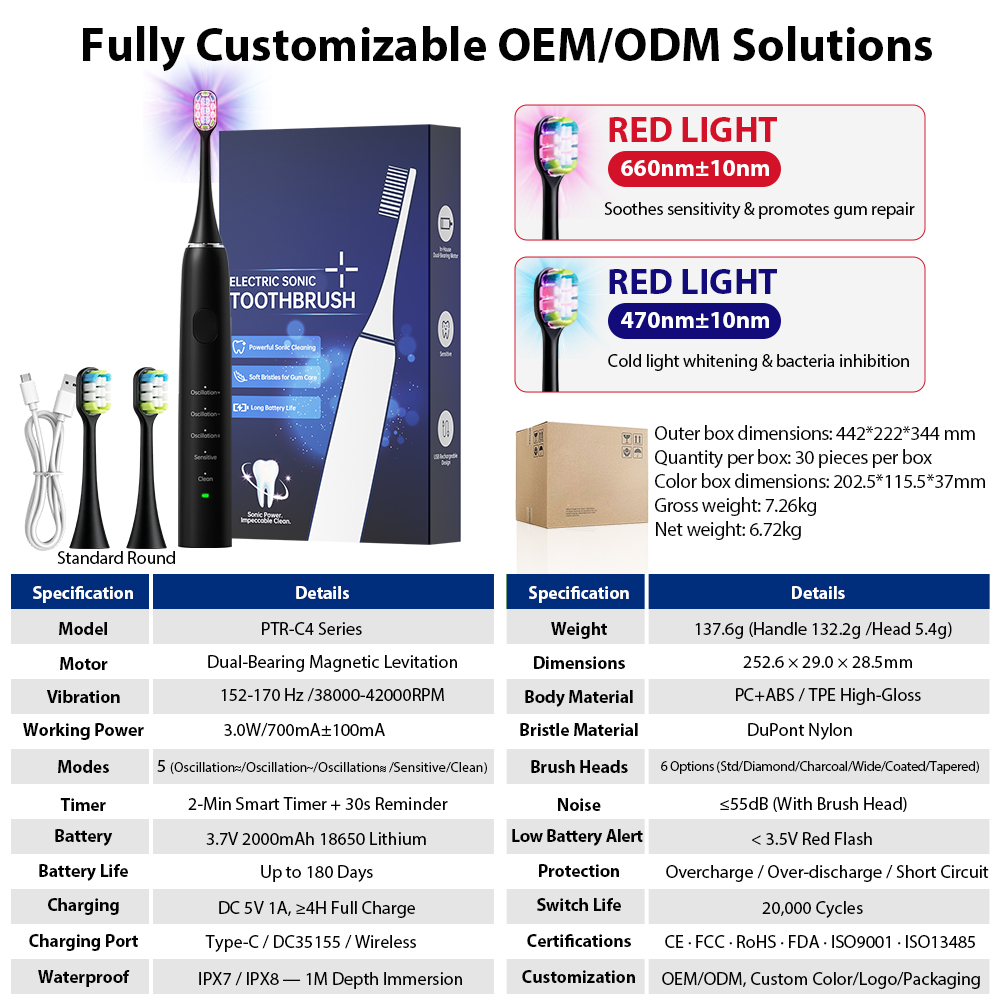
POWSMART provides OEM, ODM, and private label manufacturing support for international electric toothbrush businesses seeking to establish products for the Netherlands and other markets.
6. What Dutch Importers Should Evaluate When Selecting a Manufacturer
Choosing a manufacturing partner requires a structured review of both the product and the supplier relationship.
Product Specifications and Sample Approval
Request a complete specification for each proposed model. The specification should identify the product configuration, materials where relevant, charging method, battery information, included accessories, packaging, and other characteristics important to the purchasing decision.
Evaluate samples against the intended retail positioning. Any changes agreed after sample approval should be documented to avoid confusion during mass production.
Quality Control and Production Consistency
Importers should understand how the manufacturer controls incoming materials, production processes, assembly, inspection, and finished-product quality.
The purchasing agreement should define the applicable inspection process and acceptance criteria. Buyers should also clarify how nonconforming products are handled and what records are available for traceability.
A supplier’s quality process is more useful when its responsibilities and procedures are clearly explained than when it is described through general promises.
Product Safety and Regulatory Documentation
Products entering the Netherlands must meet the requirements applicable to their design, intended use, and classification.
Depending on the product, relevant considerations may include electrical and battery safety, electromagnetic compatibility, restrictions on hazardous substances, radio equipment requirements for wireless features, chemical compliance, packaging obligations, and applicable EU conformity assessment procedures.
Not every requirement applies to every electric toothbrush. For example, wireless functionality can introduce obligations that do not apply to a basic model without radio features.
Importers should establish who is responsible for testing, technical documentation, conformity assessment, declarations, labeling, and maintaining records. They should independently verify that the documentation matches the exact model being imported.
Where the product is subject to applicable EU rules requiring CE marking, the manufacturer and other responsible economic operators must meet their respective obligations. CE marking should not be treated as a generic quality award or as a substitute for checking the underlying compliance documentation.
Dutch-Language Information and Packaging
Businesses selling consumer products in the Netherlands should assess the language requirements applicable to product safety information, instructions, warnings, and other consumer-facing materials.
Dutch-language information may be necessary depending on the product and applicable rules. Importers should confirm the exact requirements for their product category before approving artwork.
Packaging should also communicate the product’s contents and main features accurately. If a product is sold in several European countries, the buyer may need a coordinated localization plan for packaging, instructions, and online product pages.
Wholesale Pricing and Total Landed Cost
The factory price is only one component of the final cost. Buyers should also account for packaging, tooling or customization where applicable, freight, insurance, customs duties, import VAT, warehousing, marketplace fees, and after-sales costs.
A useful quotation should make the product configuration and commercial assumptions clear. Comparing quotations for different accessories, packaging specifications, or order quantities can lead to misleading conclusions.
Dutch importers should calculate the expected landed cost before agreeing on retail prices or distributor margins.
Minimum Order Quantities and Replenishment
Minimum order quantities influence inventory exposure, product testing, and the ability to manage multiple models.
A business introducing a new product may prefer a focused initial assortment, while an established distributor may have the volume to support several variants. Buyers should confirm minimum quantities for standard products, customized colors, logo application, and packaging separately.
Replenishment planning should include production lead times, shipping time, seasonal demand, and the possibility of delays. The appropriate inventory buffer depends on the business model and sales history.
Communication and Long-Term Supply
Clear communication helps prevent mistakes involving artwork, specifications, product options, and shipping arrangements.
Before placing an order, agree on the approval process, key production milestones, inspection requirements, shipment documents, and procedures for resolving quality concerns.
A manufacturer that can explain its capabilities and limitations clearly provides a stronger basis for a long-term relationship than one that makes broad promises without defining the project details.
7. Building an Electric Toothbrush Product Range for the Netherlands
A product range should reflect the buyer’s distribution strategy rather than simply maximize the number of available models.
For example, an importer serving general retail may prioritize a small selection of clearly differentiated products at different price points. An online brand may focus on a more distinctive design and consistent packaging. A wholesaler supplying several customer types may need a broader selection, but only where the expected demand justifies the added inventory.
A practical product planning process includes:
- Define the target channel. Decide whether the products are intended for retail chains, independent shops, online marketplaces, specialist distributors, or direct-to-consumer sales.
- Select the customer segment. Determine whether the assortment is aimed at entry-level buyers, families, travelers, or customers seeking more feature-rich products.
- Choose a manageable product range. Select models with clear differences in features, positioning, and price.
- Confirm customization requirements. Decide which elements need to be customized, including logos, colors, packaging, and accessories.
- Verify compliance responsibilities. Identify the requirements for each model and establish who will provide and maintain the necessary documentation.
- Calculate the commercial model. Estimate landed costs, target margins, expected order volumes, and replenishment needs.
- Approve samples and production specifications. Ensure that the approved product and packaging match the agreed requirements before mass production.
This approach helps buyers align manufacturing decisions with the actual needs of their Dutch distribution business.
8. Why Work with a China-Based Electric Toothbrush Manufacturer?
For Dutch businesses sourcing internationally, a China-based manufacturer can provide a manufacturing relationship that supports product selection, customization, and repeat purchasing.
The value of the relationship depends on the manufacturer’s actual capabilities, product consistency, communication, documentation, and ability to meet the agreed commercial requirements.
POWSMART works with international businesses looking for electric toothbrush manufacturing solutions for wholesale, OEM, ODM, and private label projects.
Potential areas of cooperation include:
- Selecting suitable electric toothbrush models for a target customer group.
- Discussing private label branding and packaging requirements.
- Evaluating product configurations for different retail price tiers.
- Coordinating sample review and production specification approval.
- Clarifying order quantities, lead times, quality requirements, and shipping arrangements.
- Supporting product development for businesses selling in the Netherlands and other international markets.
POWSMART is based in China and supplies international markets through manufacturing cooperation. This positioning does not imply that the products are manufactured locally in the Netherlands.
For importers and brands, the most suitable arrangement depends on the specific product, the buyer’s volume, the intended distribution channel, and the responsibilities agreed by both parties.
9. Frequently Asked Questions About the Dutch Electric Toothbrush Market
Can Dutch businesses source electric toothbrushes directly from a manufacturer in China?
Yes. Dutch importers, wholesalers, retailers, and brands can explore direct sourcing from China-based manufacturers. Before ordering, they should evaluate product specifications, samples, manufacturing quality, compliance documentation, landed cost, shipping arrangements, and after-sales responsibilities.
Does POWSMART provide private label electric toothbrush manufacturing for the Netherlands?
POWSMART offers OEM, ODM, and private label manufacturing services for international customers. Dutch businesses can discuss their product requirements, branding plans, packaging preferences, and expected order quantities to determine which manufacturing arrangement is suitable.
What is the difference between OEM and ODM electric toothbrushes?
OEM manufacturing generally follows a buyer’s defined product requirements, while ODM projects use a manufacturer’s existing design or development capabilities as a starting point. The exact division of responsibilities depends on the agreed project scope and contract.
What should an electric toothbrush importer check before placing an order?
The importer should review product samples, written specifications, quality control procedures, applicable regulatory documentation, packaging and language requirements, minimum order quantities, production lead times, shipping terms, and the total landed cost.
Are Dutch-language instructions required for electric toothbrushes?
Language requirements depend on the product and the rules applicable to its sale. Importers should verify which instructions, warnings, and consumer-facing information must be available in Dutch before approving packaging and product documentation.
Can one electric toothbrush product be sold across several European markets?
Potentially, but the importer must verify the applicable requirements in each destination country. Packaging, instructions, product listings, conformity documentation, and national obligations may need to be reviewed before launching the same model in multiple markets.
How should a Dutch wholesaler choose the right product range?
Start with the intended sales channels and customer groups. Compare the commercial suitability of each model, establish clear product tiers, calculate landed costs, and avoid carrying more variants than the business can support effectively.
What information should be included in an OEM or private label inquiry?
A useful inquiry includes the intended product type, estimated order quantity, target price range, preferred customization, packaging requirements, destination market, expected delivery schedule, and any known compliance or documentation requirements.
10. Contact POWSMART for Electric Toothbrush Manufacturing
The Netherlands offers several potential routes for electric toothbrush distribution, from general retail and specialist oral care channels to wholesale supply and online brand development. Businesses entering this market need a manufacturing partner that understands the importance of product selection, branding, quality requirements, compliance planning, and dependable supply coordination.
POWSMART is a China-based electric toothbrush manufacturer supporting international businesses with OEM, ODM, and private label manufacturing solutions.
Whether you are an importer developing a new oral care assortment, a wholesaler evaluating additional products, a retailer planning a private label range, or an online business building an electric toothbrush brand, POWSMART can discuss your project requirements and potential manufacturing options.
Visit the POWSMART website to explore its electric toothbrush manufacturing capabilities and discuss products intended for the Netherlands and other international markets.
POWSMART — Electric Toothbrush Manufacturer for International Markets
Website: https://www.powsmart.com/
Markets: https://www.powsmart.com/toothbrush/markets/
Contact POWSMART to discuss electric toothbrush OEM, ODM, private label, and wholesale manufacturing requirements for the Dutch market.