Why Is Motor Technology Important for Water Flossers?
The motor is a key component of an electric water flosser because it drives the pump that generates the water stream. Its operating characteristics can influence pressure stability, pulse frequency, noise, and battery consumption.
For B2B buyers, choosing a suitable motor requires evaluating the intended product category, target users, water pressure requirements, battery capacity, and overall handle structure. A well-matched motor and pump system can help manufacturers achieve consistent performance while balancing product size and operating efficiency.
What Are the Advantages of Brushless Motors in Water Flossers?
Brushless motors operate without traditional mechanical brushes, reducing brush-related friction and wear. Depending on the motor design and electronic control system, they may support efficient operation, stable speed control, and reduced maintenance requirements.
For brands considering Brushless motor water flosser OEM, customization can involve motor specifications, control parameters, pump integration, and product structure. Buyers should evaluate operating speed, torque, heat generation, noise, and power consumption under actual working conditions rather than relying on motor specifications alone.
How Can Coreless Motors Support Oral Irrigator Design?
Coreless motors feature a lightweight rotor structure without a conventional iron core. Their low rotor inertia can support responsive operation and compact mechanical designs, making them an option for certain portable oral irrigator applications.
Through Coreless motor oral irrigator ODM development, brands can work with manufacturers to assess motor dimensions, voltage requirements, speed characteristics, and compatibility with the pump assembly. The final water-flossing performance still depends on the complete system, including pump structure, water channels, and electronic controls.
What Should Buyers Compare Between Brushless and Coreless Motors?
Both motor technologies have distinct characteristics, and the best option depends on the product’s design objectives.
Key comparison factors include:
- Operating efficiency: Evaluate power consumption during normal use.
- Noise and vibration: Test the complete device rather than the motor alone.
- Size and weight: Confirm compatibility with portable handle dimensions.
- Pump performance: Check whether the motor can support the required pressure and flow rate.
- Durability: Assess performance through repeated operating cycles.
- Cost structure: Consider component pricing, control electronics, and assembly complexity.
Prototype testing helps buyers determine which motor solution best matches their product positioning and target price range.
How Do Motor and Pump Systems Affect Water Flossing Performance?
A water flosser’s performance depends on the coordination between the motor, pump, water tank, flow channels, and nozzle. Motor speed and control parameters influence how the pump generates pressure and pulses, while pump design determines how water is delivered through the nozzle.
Manufacturers should evaluate water pressure consistency, pulse frequency, flow rate, leakage prevention, and nozzle compatibility. They should also consider how different operating modes affect battery consumption and user comfort.
For OEM and ODM projects, integrated system testing is essential to ensure that the selected motor delivers suitable performance in the finished product.
What Quality Tests Should Be Completed Before Mass Production?
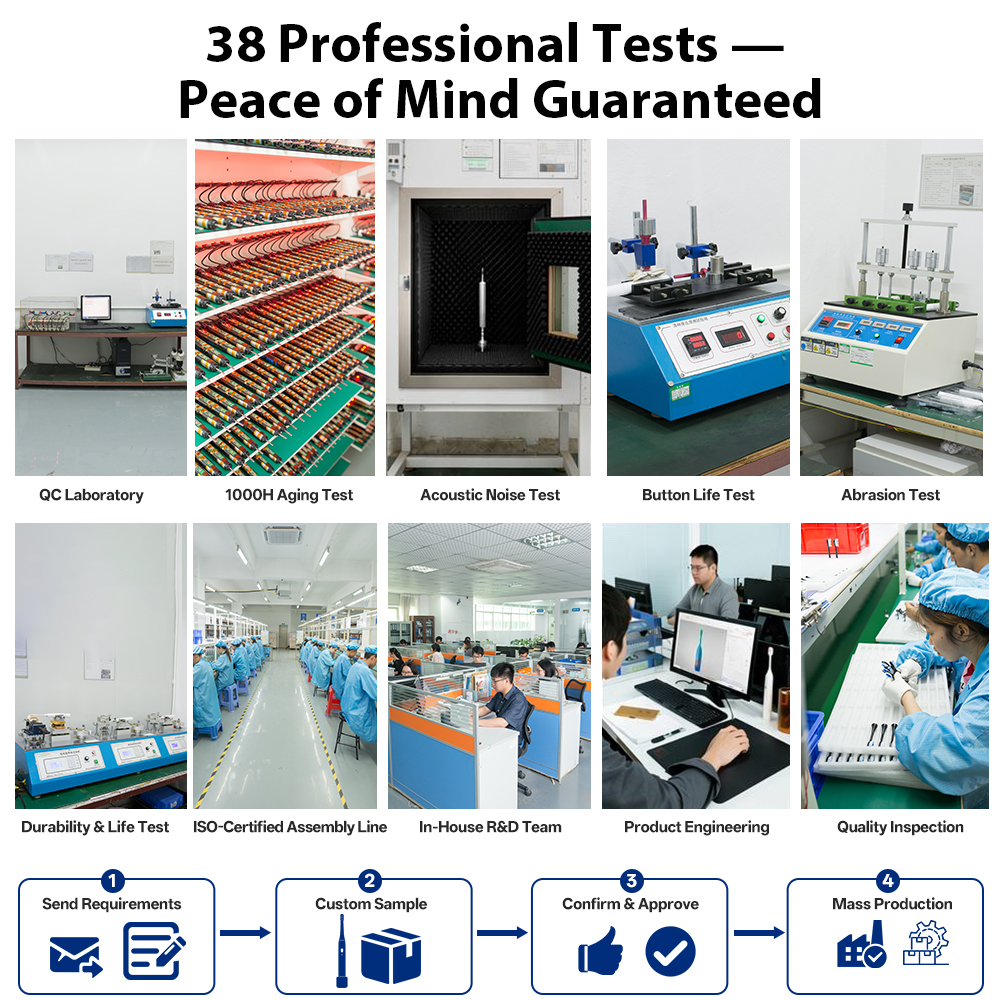
Before approving bulk production, buyers should request prototypes and review the manufacturer’s testing procedures. Recommended evaluations may include motor operating stability, water pressure consistency, flow-rate testing, noise levels, battery runtime, waterproof performance, and repeated-use durability.
Manufacturers should also establish incoming component inspections, pump assembly checks, electrical safety evaluations, and final product inspections. Clear technical specifications and documented acceptance criteria help maintain consistency between approved samples and mass-produced units.
Conclusion
Choosing the right motor technology is essential for developing a water flosser that balances performance, efficiency, size, and reliability. Whether selecting Brushless motor water flosser OEM or Coreless motor oral irrigator ODM services, brands should work with a capable manufacturing partner to evaluate motor compatibility, optimize pump integration, and verify the complete product through practical testing. Contact us