Introduction
Understanding the underlying financial inputs of consumer healthcare electronics controls your wholesale procurement margins and pricing leverage. For international procurement directors, breaking down production line expenses represents a vital strategy during annual budgeting phases. Consequently, evaluating the exact cost structure of electric toothbrush manufacturing helps your brand optimize capital allocation workflows. Vague cost assumptions lead to overpriced purchase contracts, which erode your retail profitability across highly competitive markets. Conversely, mapping out specific mechanical and electronic expense categories empowers sourcing teams during factory contract negotiations. Our transparent smart production facility provides detailed component pricing maps to support your enterprise growth strategies.
Furthermore, analyzing an advanced oral care device goes far beyond looking at simple external plastic resin prices. True financial clarity requires examining core drive systems, printed circuit board assemblies, premium filaments, and specialized molding. This comprehensive guide details the key expenditure categories that shape premium sonic device production budgets today.
Core Electronic Components and Precision Motor Allocations
The internal drive mechanics and lithium battery cells dominate the primary bill of materials across all production batches. Sourcing teams must identify premium internal components to guarantee long-term device durability and high operational reliability.
The primary maglev sonic motor typically accounts for 25% of the total unit bill of materials. This allocation highlights the technological weight of internal drive systems within the cost structure of electric toothbrush manufacturing. Our high-torque Duplex Bearings Maglev Motors deliver superior cleaning dynamics while maintaining tight factory cost efficiencies. Additionally, the smart printed circuit board assembly (PCBA) requires approximately 15% of the overall production budget. This electronic core manages protective pressure sensors, multi-speed cleaning modes, and optimal battery charging cycles over multiple years. Sourcing stable microcontrollers ensures your inventory performs consistently across international distribution networks without expensive hardware failures.
Raw Material Sourcing and Amortized Custom Mold Tooling
External housing resins, premium bristle filaments, and custom industrial injection molds represent the remaining hardware financial inputs. Sourcing managers must balance upfront engineering investments against recurring unit material expenditures to maximize return on investment.
Food-grade ABS handle housings and premium DuPont Tynex filaments together consume 20% of the recurring unit budget. Selecting these high-grade materials enhances your cost structure of electric toothbrush manufacturing by reducing product defect rates. Furthermore, creating custom aesthetic handle shapes requires a upfront injection mold tooling investment between 8,000 and 30,000 USD. For expanding brands, our facility amortizes these fixed engineering costs over large production contracts to lower initial capital barriers. Our automated assembly floor minimizes manual labor costs, keeping operational overhead under 15% of the total unit price.
High-Performance Hardware and Certified Quality Standards
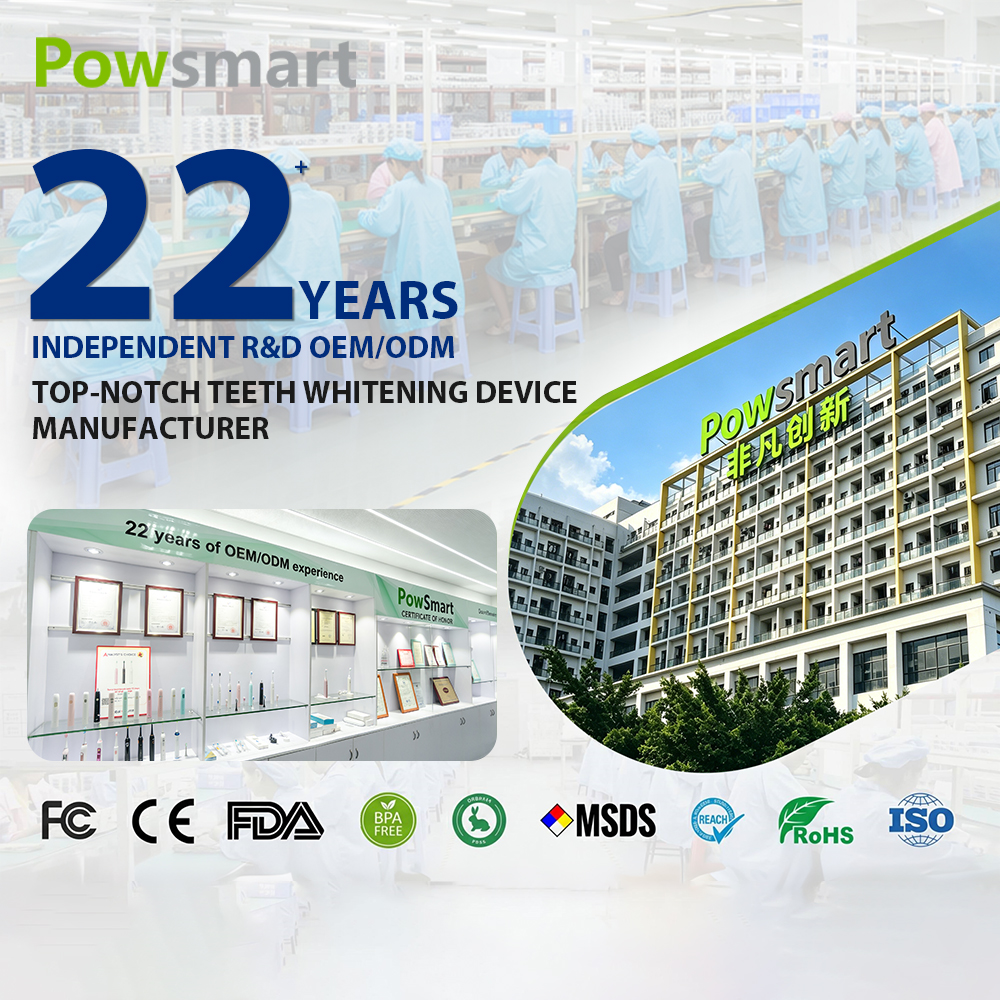
Our automated factory combines deep cost optimization with elite internal component engineering and globally recognized certification records. We protect your commercial market launch by executing a rigorous gauntlet of 38 distinct industrial reliability tests.
Our underlying electronic handle platform holds an exceptional 9.75 out of 10 performance score from Underwriters Laboratories (UL). The laboratory data verifies our power systems deliver an efficient battery life that lasts three times longer. For instance, our premium PTR-E10 model operates for up to 250 days on a single Type-C charge. We support your commercial scale by offering highly competitive low MOQs starting at 1,000 pieces for standard designs. Sourcing teams can also procure matching portable water flossers and custom LED teeth whitening accessories.
To evaluate detailed price breakdown sheets and download technical spec files, please check the powsmart.com custom pricing page. To study international raw material industrial standards, you can visit the electronic resource database of the Underwriters Laboratories portal.
Conclusion
In summary, controlling component expenditure details is crucial for maintaining a highly competitive position in the wellness sector. Dissecting the cost structure of electric toothbrush manufacturing reveals strategic opportunities to save on tooling and components. Partnering with an engineering-focused factory provides access to transparent pricing models, durable maglev motors, and certified UL reliability. Contact our financial optimization experts today to design a high-margin oral care catalog that accelerates your business.
.jpg)
