In the rapidly evolving world of teeth whitening tech, light-assisted whitening has become a defining feature for both consumer and professional products. As brands explore OEM applications to launch their own whitening devices, a critical question arises — is LED scientifically superior to UV light? Understanding the difference is vital for making evidence-based product development decisions and ensuring both efficacy and safety.https://www.powsmart.com/product/teeth-whitening/
Both LED and UV technologies function by accelerating the chemical reaction of whitening agents, typically hydrogen peroxide or carbamide peroxide. These reactions release free radicals that break down stains on the enamel surface.
However, the scientific foundation behind each light source differs:
UV (Ultraviolet) light operates at shorter wavelengths (100–400 nm), providing higher energy photons that can speed up reactions but also risk tissue irritation or enamel sensitivity.
LED (Light Emitting Diode) light emits within the visible spectrum (400–700 nm), offering a more controlled and safer approach with less heat generation and no ionizing radiation.
This shift from UV to LED is not just a marketing trend—it’s rooted in physics and biocompatibility.
| Criteria | LED Technology | UV Technology |
| Safety | Non-ionizing, minimal tissue risk | Potential for soft tissue irritation |
| Energy Efficiency | Low energy use, minimal heat | High energy, often generates heat |
| Longevity | Long-lasting diodes | Shorter lifespan, higher maintenance |
| Consumer Perception | Seen as safer and modern | Increasingly outdated due to safety concerns |
For OEM manufacturers, these differences directly impact product certification, shelf appeal, and user satisfaction.
Modern research increasingly supports evidence-based whitening protocols that favor LED systems. Clinical studies have shown that LED-assisted whitening achieves comparable or better stain removal than UV-based systems, without increasing tooth sensitivity or enamel damage.
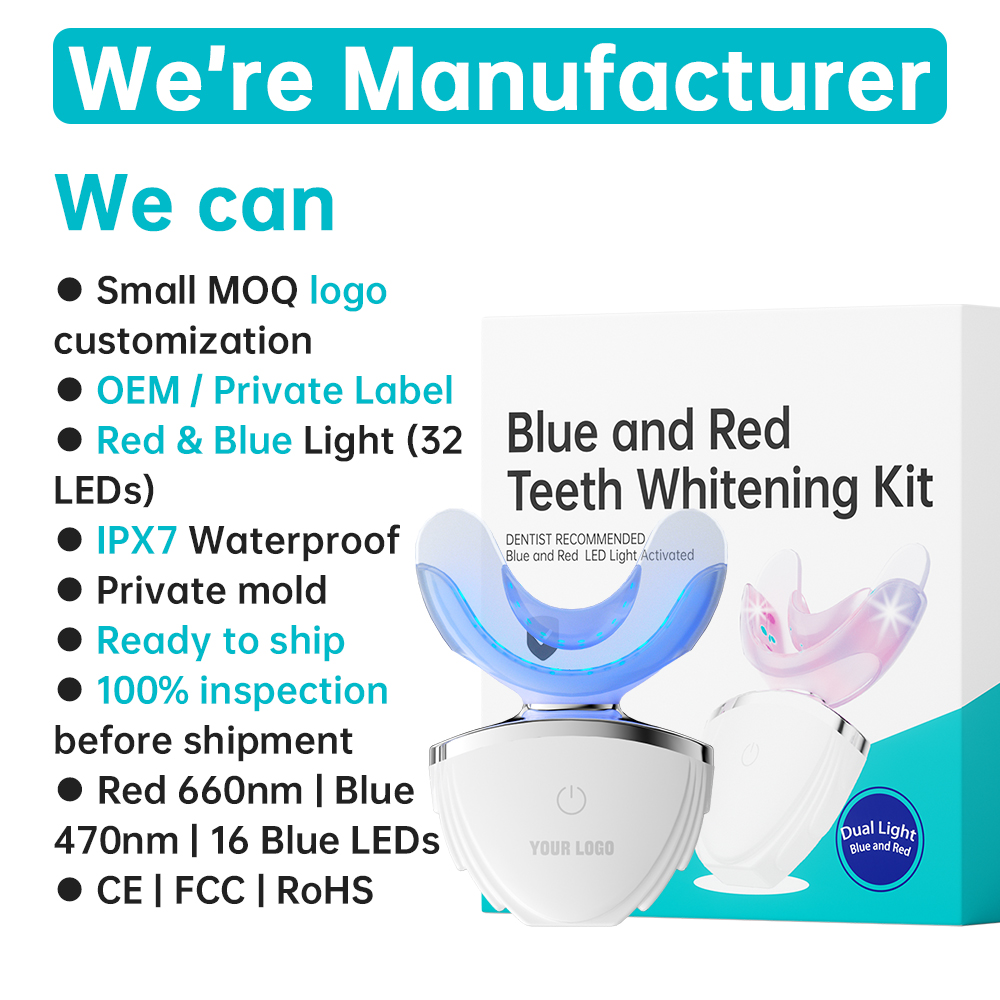
Moreover, LED devices allow for more customizable wavelengths (often in the blue light range, around 460–480 nm), optimizing peroxide activation while minimizing adverse effects. This scientific evidence strengthens the case for LED as the superior technology for long-term consumer trust.
OEM Applications: Choosing the Right Technology for Your Brand
For OEM applications, choosing between LED and UV is both a technical and strategic decision. Brands developing private-label or customized whitening products should consider:
Regulatory Compliance: LED systems more easily meet FDA, CE, and ISO safety standards.
Market Trends: Consumer demand leans heavily toward LED-based whitening kits.
Design Flexibility: LED modules integrate seamlessly into compact, portable, and rechargeable devices.
Brand Image: “LED-powered” aligns with modern, high-tech brand positioning.
Partnering with an experienced OEM manufacturer specializing in evidence-based whitening can streamline R&D, reduce certification barriers, and ensure scientific credibility.
Conclusion
In conclusion, while both UV and LED have historical roles in teeth whitening tech, modern science and consumer trends point decisively toward LED. Its combination of safety, efficiency, and proven performance make it the LED scientifically superior choice for OEM applications.
For brands seeking to create trustworthy and effective whitening solutions, adopting LED-based systems is not just a trend — it’s an evidence-based whitening strategy that ensures long-term success in an increasingly competitive market.
Can a Whitening Booster Solution Enhance Results from UV Whitening Technology?
.jpg)
Solution for Color Customization of Water Flossers: From Pantone Code to Actual Machine – A Comparison of Two-Color Injection Molding and Gradient Spraying
.jpg)
Split Bristles Linked to Enamel Cracks? 90% of Users Ignore This Danger!
Looking for Servo Motor Customization to Achieve a Superior Bidirectional Vibration Motor Effect?

How Does Pulse Water Technology Benefit from a Smart Multi-pressure Setting Chip?How Does Pulse Water Technology Benefit from a Smart Multi-pressure Setting Chip?How Does Pulse Water Technology Benefit from a Smart Multi-pressure Setting Chip?How Does Pulse Water Technology Benefit from a Smart Multi-pressure Setting Chip?How Does Pulse Water Technology Benefit from a Smart Multi-pressure Setting Chip?How Does Pulse Water Technology Benefit from a Smart Multi-pressure Setting Chip?How Does Pulse Water Technology Benefit from a Smart Multi-pressure Setting Chip?How Does Pulse Water Technology Benefit from a Smart Multi-pressure Setting Chip?
Indicator Failure Leading Periodontal Pocket Deepening – Undetected?
Pump Seizure Plus Gingival Abrasion – Critical?
What’s Driving the Oral Care Category Now?
Peroxide Free Whitening Device Supplier for Global Oral Care Brands
Rechargeable Whitening Device OEM for Global B2B Brands
How a specialized Orthodontic Brush Head better cleans around braces and brackets
.jpg)
In-depth Analysis of the Logo Craftsmanship of Water Flossers
Can a Rechargeable Battery Solution Efficiently Power an LED Display Module?
How Does Bulk Toothbrush Heads Wholesale Benefit from Innovative Electric Toothbrush Mold Design?
Frequent Allergy Reactions to Whitening Kits: Is Cold-Light Technology to Blame?
Should You Partner with a Teeth Whitening Gel Manufacturing Expert?


.jpg)
.jpg)
.jpg)
.jpg)
.jpg)