
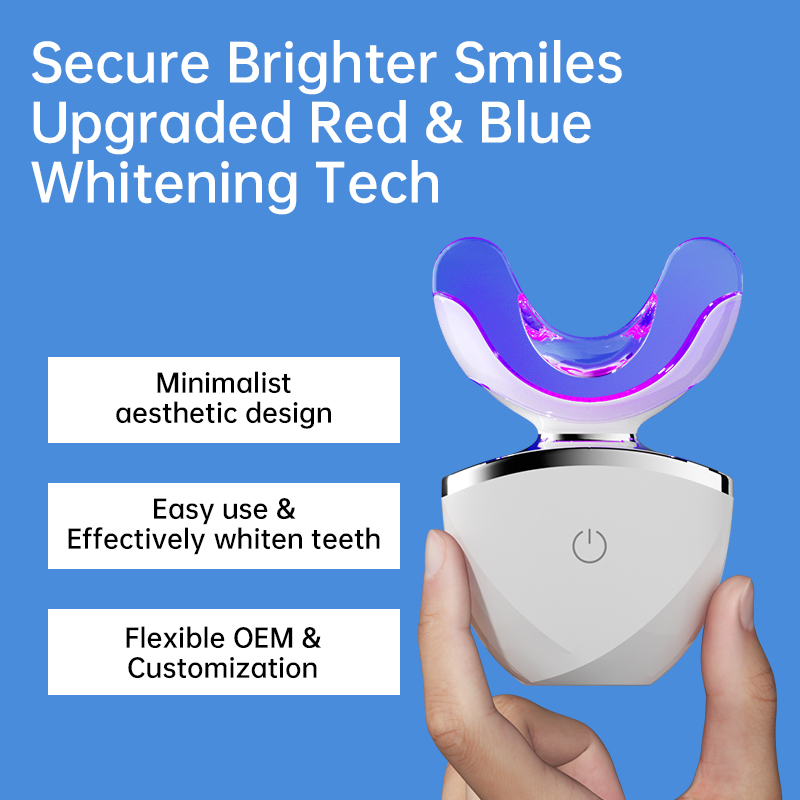
Ensuring long-term stability in an LED Whitening Light requires rigorous verification steps, and one of the most critical durability evaluations is the Pressure Decay Test. This test determines whether the device’s housing, seals, and internal components can resist micro-leakage, thermal stress, and operational pressure fluctuations under real-world conditions. For whitening device OEMs and B2B buyers, the ability of an LED Whitening Light to consistently pass this test is a direct indicator of manufacturing precision, environmental resistance, and service-life reliability. Below, we break down the engineering principles that enable durable performance.
The Pressure Decay Test exposes the LED Whitening Light to controlled internal pressure. Any structural weaknesses—such as micro-cracks, material thinning, or thermal deformation—become detectable through pressure loss patterns.
High-grade polycarbonate or reinforced ABS materials are often used to prevent warping, ensuring the device maintains its optical alignment and sealing performance over time.
Because whitening treatments often involve gels, humidity, and close oral environments, the LED chamber must remain sealed.
During the Pressure Decay Test, gasket compression ratios, O-ring materials, and ultrasonic welding lines are evaluated.
Effective sealing ensures that no moisture enters the LED cavity, preserving diode brightness and preventing internal corrosion.
LED Whitening Lights produce heat during operation, which can cause materials to expand.
A device that passes the Pressure Decay Test must show resistance to leakage even under elevated temperatures.
Manufacturers achieve this through:
Electronic drivers, wiring, and light modulation circuits must be shielded from mechanical stress and micro-vibration caused by pressure fluctuations.
The Pressure Decay Test verifies that the internal layout minimizes component movement and prevents solder joint fatigue.
This ensures consistent LED pulse output—critical for whitening efficacy and safety.
Any distortion of the lens frame or LED mount may affect the whitening beam.
By passing a Pressure Decay Test, the LED Whitening Light demonstrates that its optical path remains stable under mechanical load.
Maintaining precise LED-to-lens alignment is essential for:
In clinical and consumer whitening systems, LED devices undergo repetitive handling, movement, cleaning, and environmental exposure.
Pressure Decay Test performance indicates whether the device can withstand:
A high-quality LED Whitening Light that withstands a rigorous Pressure Decay Test demonstrates robust sealing, structural stability, thermal resilience, and reliable electronic protection. For manufacturers and B2B buyers, this ensures a whitening device that performs consistently, resists environmental challenges, and delivers long-term value to end-users. Contact us
.jpg)
Electric Toothbrush Troubleshooting Flowchart: A Practical OEM Guide for Brands
Why an IT professional toothbrush needs a Desk charging station
Can an electric toothbrush Houston truly elevate your Houston dental care routine?
.jpg)
Pulse Instability plus Enamel Erosion – Linked?
The Reasons and Solutions for the Electric Toothbrush Not Responding When Turned On

How to Optimize Electric Toothbrush Production Lead Time? Strategies for Shortening Lead Times and Enhancing Brand Competitiveness
Small Batch Electric Toothbrush OEM Manufacturing for Emerging Brands

Is Your Kids-safe Design Verified to Use Non-toxic Material?
Red Blue Light Electric Toothbrush OEM Manufacturing
Why Is Enamel Vulnerability Linked to Staining Residuals?

Benefits of Electric Toothbrushes: Why Brands Should Invest in electric toothbrush Quality Manufacturing
.jpg)
Are You the Leading Water Flosser Nozzle Supplier for High-Volume Replacement Head Production?
Why Does Charging Failure Coincide with Tank Odor? Hidden Links Unveiled
Wholesale Electric Toothbrush San Antonio – Affordable Oral Care for Businesses
Waterproof Failure Causes Battery Leakage? Deadly Electric Toothbrush Flaw!
How Can R&D Collaboration Be Guided by Market Trend Analysis?


.jpg)
.jpg)
.jpg)
.jpg)
.jpg)







.jpg)