electric toothbrush battery life has become one of the most important performance indicators for B2B oral care brands competing in international markets.
From a procurement perspective, battery life directly affects customer satisfaction, return rates, and product positioning. Therefore, battery performance must be designed systematically rather than treated as a marketing specification.
Why Battery Life Matters in B2B Electric Toothbrush Projects
For distributors and brand owners, short usage time leads to frequent charging complaints. Over time, this increases after-sales costs and negatively impacts brand reputation.
Moreover, different markets have different expectations. In Europe and North America, longer usage cycles are often associated with premium quality. As a result, battery endurance influences both pricing strategy and channel acceptance.
Battery Capacity Selection and Structural Constraints
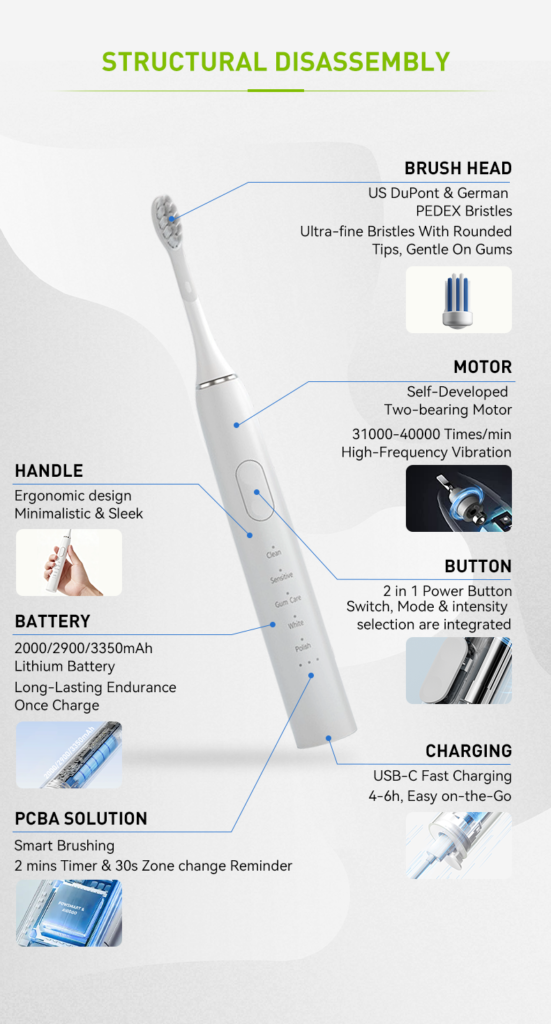
Battery life engineering starts with capacity planning. Lithium-based rechargeable batteries are commonly used due to their energy density and stability.
However, capacity selection involves trade-offs. Larger batteries increase usage time, but they also affect handle size, weight balance, and charging duration.
Therefore, manufacturers evaluate internal space, motor power consumption, and ergonomic requirements together. This ensures that capacity choices support both performance and user comfort.
Power Consumption and Motor Efficiency
Battery endurance is closely linked to motor efficiency. Sonic toothbrushes rely on stable vibration output, which consumes significant energy.
To address this, power management systems regulate energy delivery based on selected brushing modes. Lower-intensity modes consume less power, while high-performance modes are optimized for efficiency rather than raw output.
As a result, brushing performance remains consistent throughout the battery cycle.
Firmware Logic and Energy Optimization
Firmware plays a key role in battery optimization. Intelligent control systems manage vibration duration, standby power, and automatic shut-off functions.
In addition, idle energy consumption is reduced through sleep modes. Consequently, energy waste during non-use periods is minimized.
These firmware strategies extend usable time without increasing battery capacity.
Charging Systems and Battery Longevity
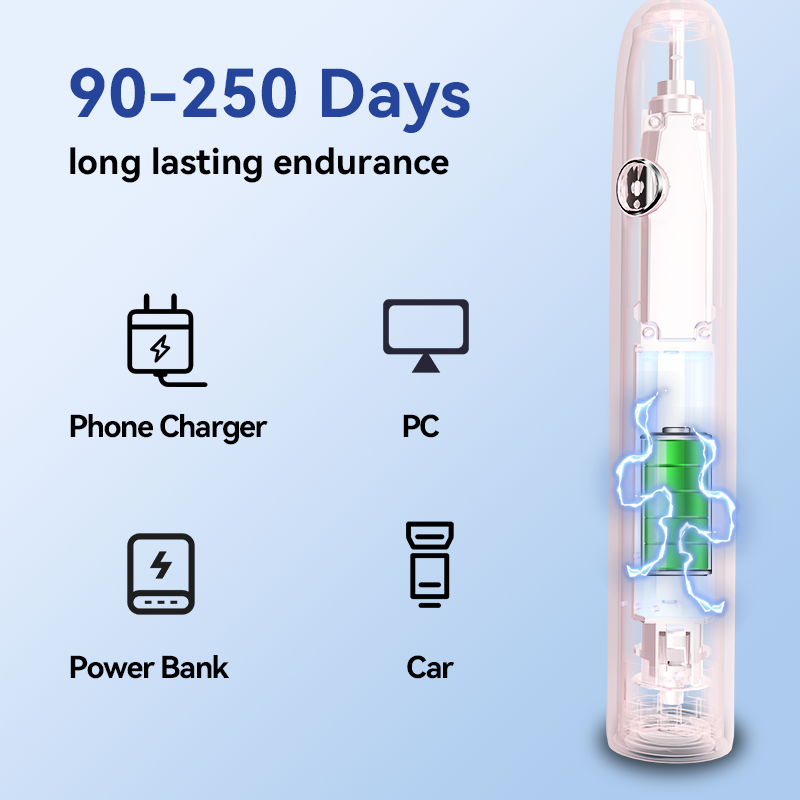
Charging design directly affects long-term battery performance. USB and inductive charging systems incorporate protection circuits to prevent overcharging and overheating.
Furthermore, charging current and voltage are controlled to maintain battery health over repeated cycles. As a result, performance degradation slows down significantly.
This improves long-term reliability and reduces warranty risks for B2B buyers.
Testing and Validation of Battery Performance
Battery performance is verified through repeated charge-discharge testing. Simulated daily usage cycles help identify early degradation or instability.
Because testing is integrated into production validation, performance consistency is ensured before mass shipment.
In addition, environmental testing evaluates performance under different temperature and humidity conditions.
Impact on Product Positioning and Market Acceptance
Extended usage time supports premium positioning and enhances perceived quality. Fewer charging cycles improve convenience for end users.
Therefore, brands often align battery performance targets with pricing and market strategy.
You can explore electric toothbrush manufacturing solutions optimized for battery performance at
👉 https://www.powsmart.com
For battery safety and performance standards, manufacturers often reference IEC guidelines:
👉 https://www.iec.ch
Conclusion
Well-engineered electric toothbrush battery life delivers stable performance, reduces after-sales risk, and strengthens competitiveness for global B2B brands.
.jpg)
