In today’s competitive oral care market, product quality is no longer just a technical matter — it’s a business survival issue. The brush head, often seen as a small component, plays a crucial role in customer satisfaction and safety. Recently, several toothbrush manufacturers have issued warnings to brand owners: it’s time to stop using brush heads that fail to meet modern performance and safety standards. Whether you’re managing a new DTC oral care brand or a private-label OEM line, reviewing your brush head supplier could be the key step to protect your brand.
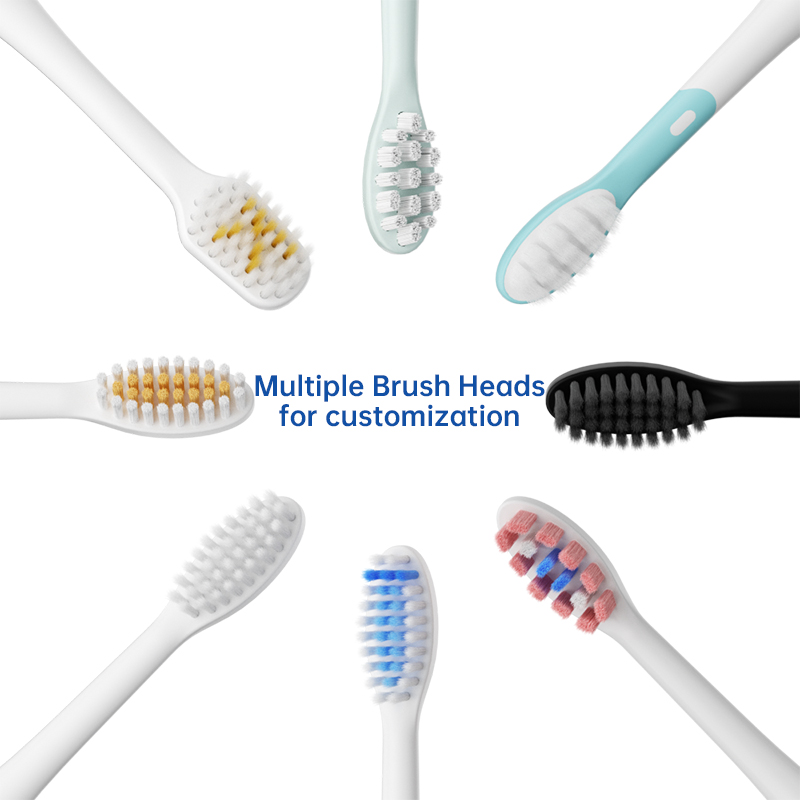
Not all brush heads are created equal. Outdated models—especially those using recycled plastics, poor bristle alignment, or untested adhesives—can cause more harm than good.
Brands continuing to use these designs face significant risks, including:
Brush heads loosening during use
Excessive bristle shedding
Irritation due to rough or uneven bristles
Compatibility issues with electric handles
These quality problems not only frustrate consumers but also represent serious OEM risk control failures. Once negative reviews or returns pile up, the damage to your brand image can be lasting and costly.
According to leading OEM manufacturers, brands should immediately stop using brush heads that:
Use low-density or inconsistent bristles
Contain metal wire inside the core (non-FDA compliant)
Fail 200+ cycle durability tests
Are made without ISO-certified materials
Such brush heads might appear affordable upfront, but they carry hidden quality and liability risks. The top manufacturer advice is clear: work only with factories that can prove their quality control systems and compliance documentation.
Quality starts with transparency. To strengthen OEM risk control, brands should:
Request detailed material and compliance reports from suppliers.
Perform third-party testing for mechanical strength and hygiene.
Inspect mold precision and bristle uniformity before mass production.
Maintain documentation for CE, FDA, or ISO certification.
A trustworthy manufacturer won’t hesitate to share these reports — and often helps clients redesign older brush heads to meet current standards.
To truly protect your brand, choose a manufacturer that doesn’t just produce brush heads, but partners with you in product development and compliance.
Ideal manufacturers offer:
Medical-grade nylon or Dupont bristles
Metal-free core structures
Fully automated assembly lines for consistency
End-to-end traceability for every production batch
Partnering with a professional OEM means you don’t just reduce product risks — you also build consumer confidence and long-term loyalty.
The oral care market is moving fast. Brands that ignore manufacturing warnings risk falling behind — or worse, facing product recalls.
By implementing strong OEM risk control and following manufacturer advice, you can stop using brush heads that endanger your reputation and ensure every product leaving your line represents your commitment to safety and excellence.
.jpg)
Electric Toothbrush with Replaceable Heads – Cost-Effective and Sustainable B2B Oral Care Solution
Travel Electric Toothbrush with Case – Compact & Rechargeable B2B Supply
.webp)
Choosing a Smart Toothbrush Manufacturing Partner?
.jpg)
sonic electric toothbrush Tacoma
Texas Tax-Free Weekend Electric Toothbrush Wholesale Guide 2025
Rechargeable Sonic Toothbrush for Clinics – Professional OEM Oral Care Solutions
How Much Does It Cost to Manufacture a Toothbrush?
How to Make Your Own Electric Toothbrush
7 Reasons to Start Your Electric Toothbrush Business in 2023
SF toothbrush deals vs. San Francisco sale — which is better?
Where to Find Orlando Deals Toothbrush for Orlando Travel Toothbrush?
.jpg)
California Waterproof Toothbrush – Powsmart PTR-C8 for Beach Lifestyle
How Houston pressure sensor tech elevates Houston deals toothbrush?

How to choose a reliable electric toothbrush factory?

Cutting-edge tech makes us apart from other electric toothbrush manufacturers
Looking for Toothbrush OEM Manufacturing Services with Custom Toothbrush Branding Capabilities?


.jpg)
.jpg)
.jpg)
.jpg)
.jpg)